3D Warehouse Rendering: Optimizing Logistics Buildings from Concept to Operation
The modern logistics facility is no longer a simple industrial shell. Driven by e-commerce growth, automation, and investor scrutiny, warehouses have become highly engineered assets where layout efficiency, operational throughput, safety, and speed to market directly impact returns. In this environment, warehouse rendering has evolved from a marketing add-on into a core decision-making tool used across planning, construction, leasing, and operations.
Backed by BIM workflows, logistics simulations, and photorealistic visualization, 3D warehouse rendering allows developers and Chief Development Officers to optimize logistics buildings before ground is broken, reducing capital risk while accelerating approvals, leasing, and investor confidence. Research shows that advanced 3D modeling and BIM coordination can reduce construction change orders by up to 40%, improve logistics throughput by over 40%, and accelerate leasing decisions by 60% through immersive visualization and virtual tours.
This article explores how warehouse 3D rendering supports logistics developments from concept to operation—and how firms like Omegarender apply these tools to deliver measurable value.
Benefits Of 3D Warehouse Rendering For Planning, Construction, And Investment Decisions
3D warehouse rendering sits at the intersection of design validation, risk mitigation, and stakeholder communication. For logistics developers and CDOs, it transforms abstract plans and spreadsheets into a shared, visual decision environment—aligning architects, engineers, investors, municipalities, and tenants around one coordinated vision.
Optimized Space Planning For High-Throughput Logistics
Warehouse profitability is driven by cubic efficiency. Clear heights exceeding 40 feet, dense racking systems, and automation demand precise spatial coordination. Warehouse renders allow teams to test column grids, racking layouts, mezzanines, and automation footprints visually—well before construction documents are finalized.
By visualizing vertical and horizontal space simultaneously, developers can identify underutilized volumes, optimize aisle widths, and confirm compatibility with high-bay storage or AS/RS systems. Studies on BIM-based logistics planning show that early 3D spatial validation significantly improves space utilization while reducing late-stage redesign.
Improved Logistics Flow And Dock-To-Door Efficiency
Dock positioning, truck courts, and internal circulation directly affect throughput. Using 3D warehouse visualization, logistics teams can simulate dock-to-door workflows, trailer maneuvering, staging zones, and internal material flows.
Research using physics-based logistics simulations demonstrates that visualized layout optimization can increase pallet throughput by over 40% by identifying congestion points and inefficient routing before equipment is installed. These insights are difficult—if not impossible—to achieve through 2D plans alone.
Better Safety Planning And Compliance
Safety is both a regulatory and operational priority. Warehouse 3D renderings allow planners to visualize forklift routes, pedestrian walkways, safety zones, and emergency access in context.
When combined with BIM clash detection and logistics simulation tools, developers can validate fire egress paths, sprinkler coverage, clearances around racking, and separation between people and vehicles. This proactive approach reduces safety incidents and supports compliance with local codes and international logistics standards.
Early Clash Detection To Minimize Construction Risk
One of the most documented benefits of BIM-driven 3D modeling is early clash detection. By coordinating architectural, structural, and MEP systems in a shared 3D environment, teams can detect conflicts—such as ducts intersecting steel or sprinkler mains clashing with conveyors—before construction begins.
Industry data shows that BIM-based clash detection can reduce RFIs and unplanned field changes by up to 40%, saving millions in rework and schedule delays. For large logistics facilities with extensive MEP systems, this risk reduction is substantial.
Reduced Change Orders And Rework For Lower Capex
Late-stage changes are among the most expensive risks in industrial development. 3D warehouse rendering reduces ambiguity, helping all stakeholders fully understand the building before committing capital.
By visualizing structure, systems, and operations together, developers significantly reduce change orders caused by misinterpretation or missing coordination. Studies from large-scale construction projects attribute multi-million-dollar savings directly to early 3D coordination and visualization.
Optimize Your Warehouse Before Construction
Talk to our 3D logistics specialists
Clear Communication With Investors, Tenants, and Stakeholders
Logistics projects involve diverse stakeholders—investment committees, lenders, municipalities, anchor tenants, and operators. Each group evaluates risk differently, but all respond to clarity.
Photorealistic warehouse renderings translate complex technical data into intuitive visuals that communicate scale, quality, and operational intent. Research into real estate visualization confirms that high-quality 3D renderings improve perceived asset value and shorten decision cycles by making future conditions tangible. Read also: 3D architectural animation services.
Stronger, Faster Decision-Making For The Development Team
When teams share a common visual reference, decisions accelerate. Instead of debating abstract drawings, stakeholders can point to the same 3D scene, identify issues, and resolve them collaboratively.
This visual alignment reduces approval bottlenecks, supports faster design freezes, and keeps logistics projects on schedule—critical in a market where speed to market often determines leasing success.
Better Construction Planning And Phasing
3D warehouse models support 4D construction phasing, linking geometry with schedule data. Developers can visualize tilt-wall sequencing, crane locations, material staging, and phased occupancy.
This is particularly valuable for logistics parks where multiple buildings may be delivered in stages, allowing early tenants to operate safely while construction continues elsewhere on site.
Operational Readiness Before Groundbreaking
3D warehouse rendering allows operators to “rehearse” operations digitally. By visualizing racking, conveyors, automation, and staffing zones, logistics teams can validate workflows before equipment procurement.
This approach reduces commissioning time and ensures facilities are operationally ready on day one—a major advantage in high-volume distribution environments.
Support For Approvals, Leasing, And Marketing
Municipal approvals and leasing both benefit from visualization. Aerial warehouse renderings integrated with real-world context help planning authorities assess traffic, massing, and visual impact, while tenants gain confidence in off-plan leasing decisions. Read also: aerial 3D rendering services.
Research shows immersive 3D walkthroughs can reduce physical site visits by 40% and accelerate lease-up by 60%, particularly for speculative logistics developments. This is especially relevant for last-mile logistics hubs and mixed-use developments that combine warehousing with showroom or customer-facing spaces, where visualization standards overlap with high-quality commercial and retail renderings.
De-Risk Your Logistics Development With 3D Rendering
From feasibility to investor approval
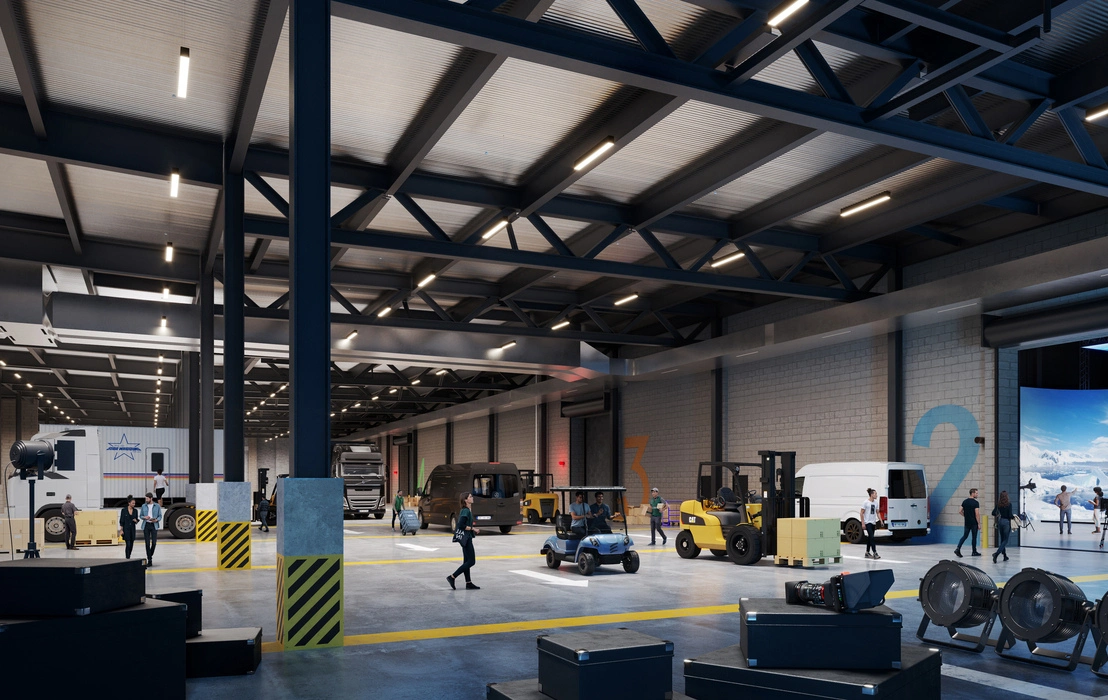
How 3D Warehouse Renderings Transform Logistic Building Design And Tenant Operations
Beyond planning and construction, 3D warehouse visualization plays a critical role in aligning building design with tenant operations and long-term flexibility.
Visualizing Warehouse Operations With 3D Simulations For Different Tenant Scenarios
Modern logistics facilities must serve diverse tenant profiles, including 3PLs, e-commerce, cold storage, and light manufacturing. For projects that combine warehousing with production areas, 3D industrial plant rendering can also help visualize equipment zones, service routes, loading areas, and operational workflows before construction begins. 3D warehouse renderings allow developers to visualize multiple operational scenarios within the same shell.
By staging different racking layouts, automation levels, and staffing patterns, developers demonstrate flexibility and reduce tenant uncertainty during leasing discussions.
Enhancing Storage Layouts Using 3D Warehouse Rendering For High-Density Storage
High-density storage solutions such as AS/RS, shuttle systems, and vertical lift modules are complex and capital-intensive. 3D visualization demystifies these systems, showing how density, access, and throughput work together.
Research on AS/RS systems highlights space savings of up to 85% compared to conventional shelving—benefits that are far easier to communicate visually than through specifications alone.
Boosting Space Utilization With Warehouse 3D Visuals And KPI-Based Scenarios
Advanced warehouse 3D visuals can be linked to KPIs such as travel distance, pick rates, and throughput. By visualizing KPI-driven scenarios, developers and tenants can compare layouts quantitatively and visually.
This data-driven visualization supports informed decisions about automation investment and layout optimization.
Supporting Inventory Management And Throughput Planning With Logistics Hub Renderings
When combined with simulation tools, warehouse design renderings support inventory flow planning, buffer sizing, and peak-season stress testing. Logistics hubs can be evaluated under different demand scenarios before physical constraints are locked in.
Designing Flexible, Custom Warehouse Concepts Via 3D Rendering For Future-Proof Logistics Parks
Future-proofing is a core concern for logistics investors. 3D warehouse rendering allows designers to test modular expansions, mezzanine additions, and automation upgrades visually—demonstrating long-term adaptability.
This flexibility increases asset resilience and supports higher exit valuations.
When Chief Development Officers Should Use Warehouse Design Rendering Services
For CDOs, timing matters. Engaging a warehouse rendering partner early maximizes value and reduces downstream risk.
Visual Support For Land Acquisition And Feasibility Studies
Before land acquisition, 3D massing and site renderings help assess buildable area, access, and visibility—supporting feasibility analysis and negotiations. Read also: 3D site plan rendering services
Aligning 3D Warehouse Design Renderings With Anchor Tenant Requirements
During concept design, 3D warehouse renderings align shell design with anchor tenant needs, reducing retrofits and strengthening pre-leasing efforts.
Using Warehouse Renders In Investment, Leasing, And Board Presentations
Ahead of investment committee meetings and leasing pitches, photorealistic warehouse renderings communicate project readiness, quality, and operational intent—de-risking decisions and accelerating approvals.
Visualize Warehouse Operations & Throughput
Layouts, flows, safety, and automation
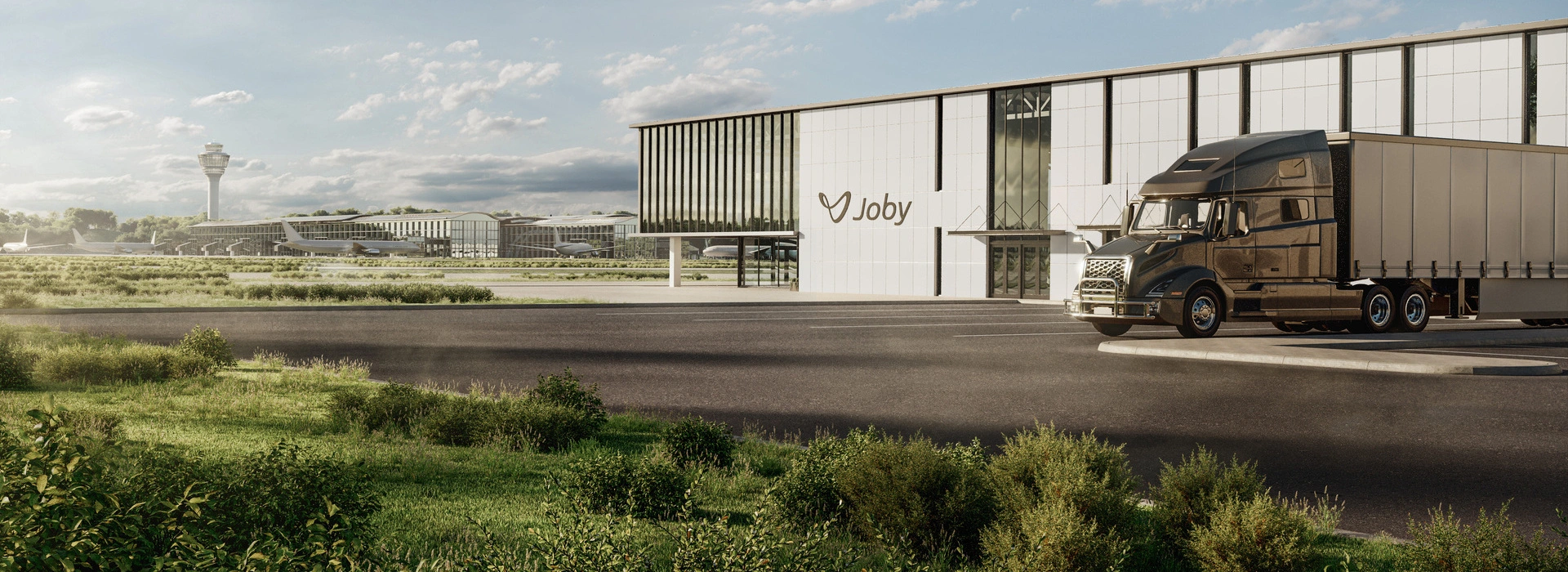
Omegarender Case Study: 3D Warehouse Rendering For A Modern Logistic Development
In a recent logistics development project, Omegarender partnered with a commercial developer to deliver exterior warehouse renderings, interior warehouse 3D visualizations, and aerial context views for a speculative logistics park.The visuals were used to:
- Optimize column spacing and dock placement during concept design
- Support municipal approvals through contextual aerial renderings
- Present multiple tenant fit-out scenarios for pre-leasing
- Accelerate investor approval by clearly communicating operational scalability
As a result, the project achieved faster approvals, reduced design revisions, and secured anchor tenant interest before construction—demonstrating how 3D warehouse rendering directly supports development outcomes.
Case Study: Somersby Logistics Park, Australia (Skylife)
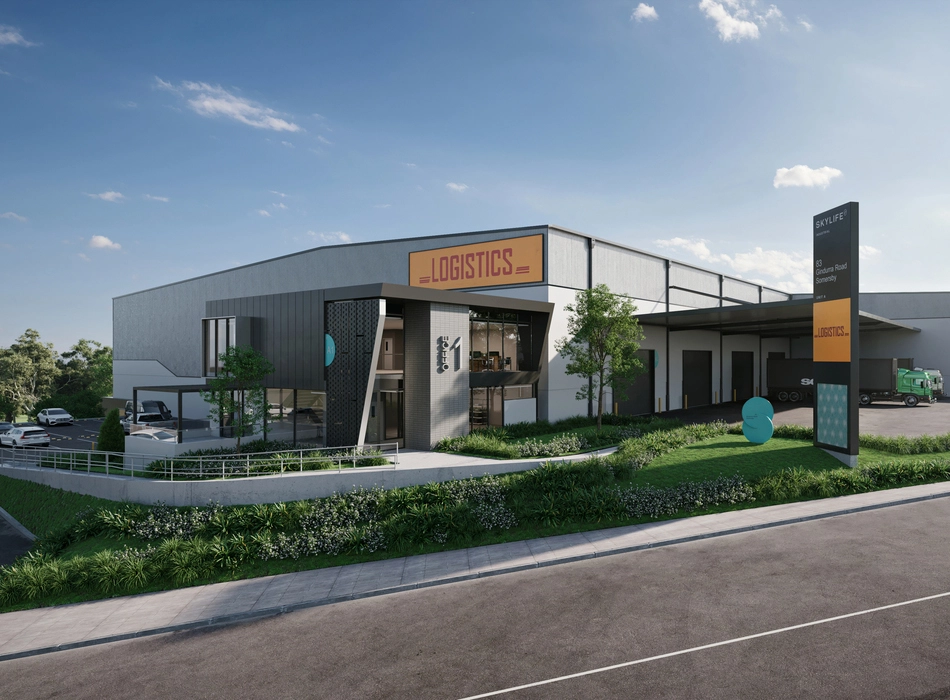
For the Somersby logistics development in Australia, Omegarender partnered with Skylife to deliver a set of high-impact commercial architectural 3D rendering services supporting design validation, approvals, and early-stage leasing. In addition to the solution, developers looking to target some of the most prominent property locations in Australia will find it useful to consider 3D rendering Sydney.
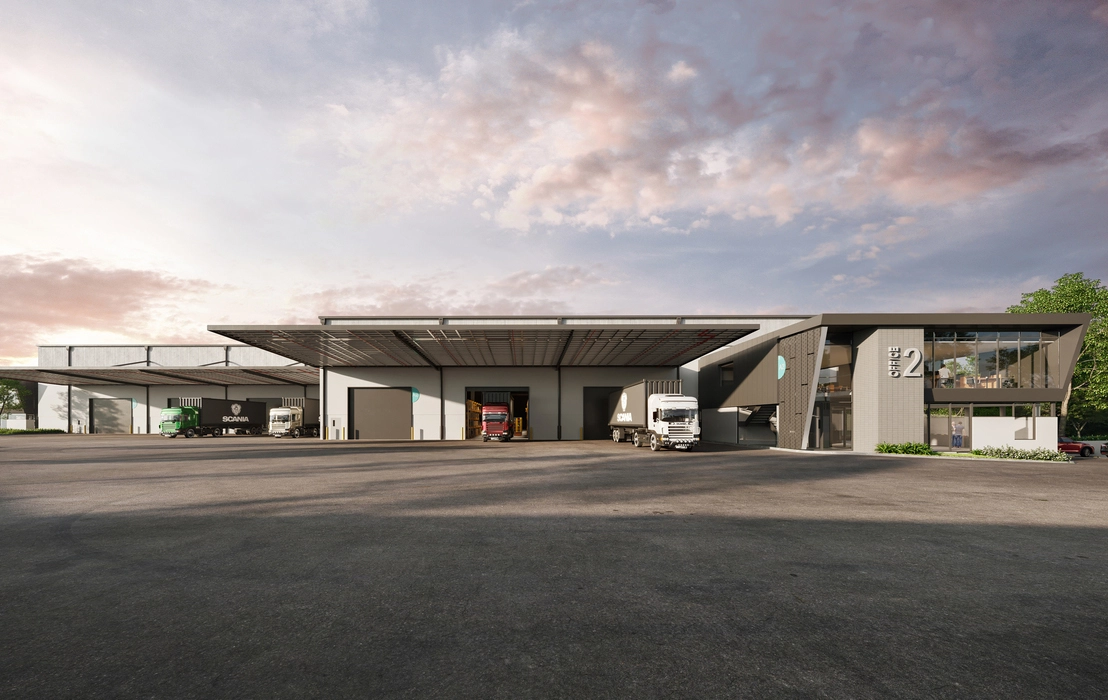
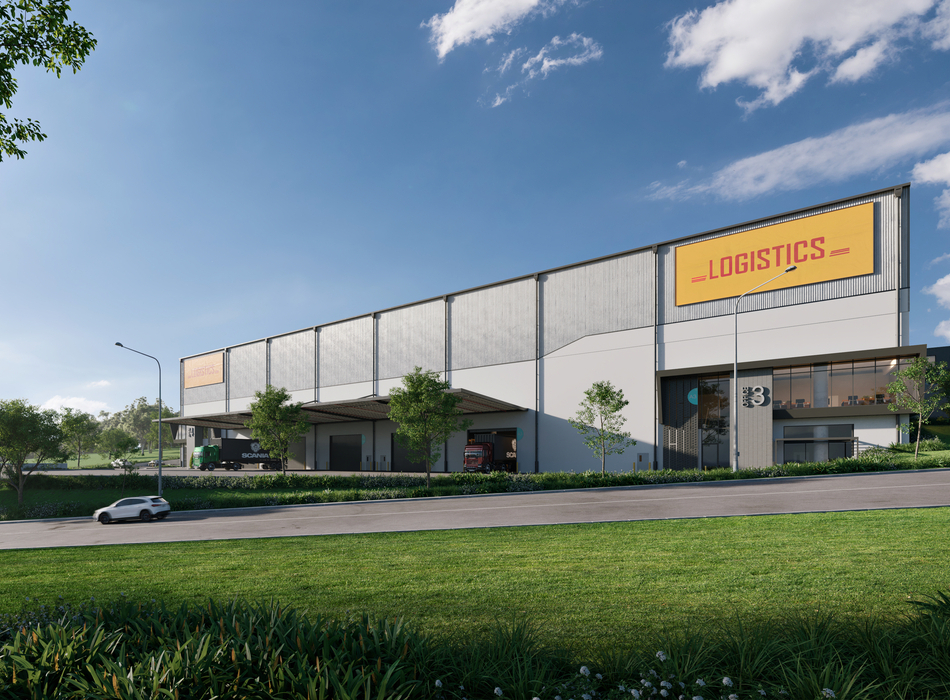
The project focused on creating clear 3D exterior rendering services and visualizations of the warehouse space that accurately communicated scale, access, and operational logic. In the course of working with external renders, special emphasis was made on developing the volume of buildings, the articulation of their facades, and differentiation of office and industrial spaces, and using aerial views and contextual images allowed illustrating access to the territory of the logistics complex and its integration into the adjacent logistics corridor.
Special attention was given to warehouse layouts, including clearly defined loading docks, truck courts, and internal storage areas, allowing stakeholders to assess circulation, docking efficiency, and future inventory changes under different operational scenarios. The renders supported discussions around peak load conditions, showcasing how vehicle flow and dock capacity could sustain high-throughput logistics operations.
Using 3D design allowed for a comprehensive visualization of the connection between offices, warehouses halls, and logistics yards. Thus, the architecture of the object became consistent not only with supply chain requirements but also with long-term logistic activity.
As a consequence, visual solutions created for Somersby allowed communicating with investors about the potential and flexibility of the logistics center.
Build it twice—once digitally, once on site.
Omegarender helps logistics developers, CDOs, and investors optimize warehouse projects through high-impact 3D warehouse rendering, BIM-aligned visualization, and operationally informed design.
FAQ
What is 3D warehouse rendering, and how does it work?
3D warehouse rendering is the creation of photorealistic or simulation-ready digital models of logistics facilities, based on architectural drawings, BIM data, and operational inputs.
What information or drawings are needed to create an accurate warehouse rendering?
Typically, site plans, floor plans, elevations, sections, BIM models (Revit/IFC), and operational requirements such as racking layouts or equipment specifications.
Can 3D warehouse renderings show racking, conveyors, and material-handling equipment in detail?
Yes. High-end warehouse renderings can accurately depict racking systems, conveyors, AS/RS, forklifts, and automation layouts.
Can 3D renderings simulate forklift routes, pedestrian flows, and safety zones inside the warehouse?
When combined with logistics simulation tools, 3D models can simulate vehicle routes, pedestrian paths, congestion, and safety buffers.
How much time does it typically take to produce a professional 3D warehouse rendering?
Exterior warehouse renderings typically take 5–14 days, depending on complexity. Animations and interactive walkthroughs require additional time.